A recent piece in The Atlantic asked: Do Your Parents Have a Screen Time Problem? The answer is yes.
January 16, 2026
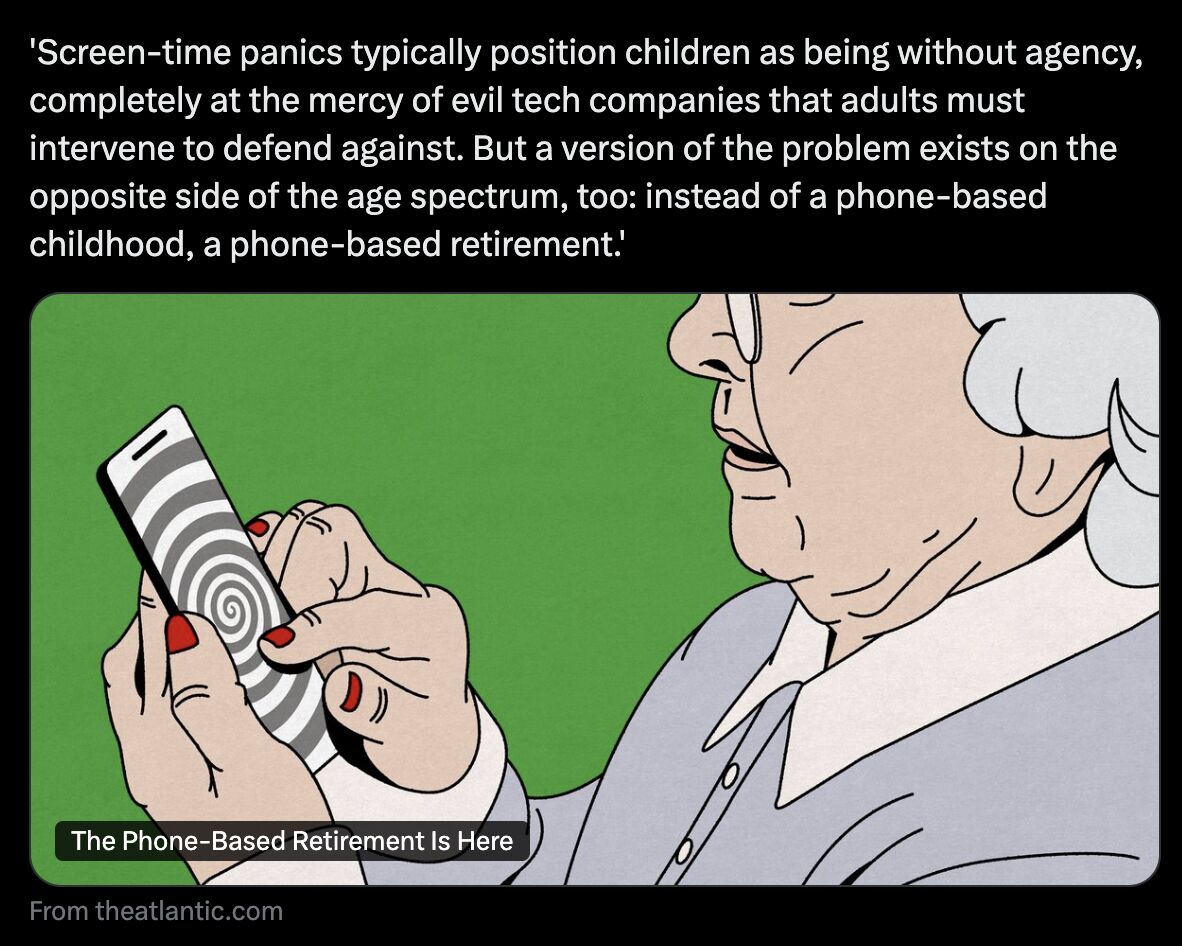
Here's something nobody's talking about: your parents might have a screen time problem.
A recent piece in The Atlantic asked a provocative question: "Do Your Parents Have a Screen Time Problem?" The answer, increasingly, is yes.
And it's time we had an honest conversation about it.
https://www.theatlantic.com/technology/2025/12/do-your-parents-have-screen-time-problem/685424/
We've spent years framing screen time as a "young people" issue. Teenagers glued to TikTok. Kids lost in video games. Millennials and their phones.
But the data tells a different story.
Older adults are spending more time on screens than ever before. And the consequences — cognitive decline, isolation, displacement of meaningful activities — are just as serious.
Maybe more so.
When I shared this article, one comment really stuck with me: "The dropping away of structure and purpose in older age" might be a key factor.
Think about it. When you retire, a lot of the built-in structure of life disappears. No commute. No meetings. No deadlines. The calendar that used to dictate your day is suddenly empty.
Into that void, the phone slides in perfectly.
Infinite content. Always available. Never boring. It fills the time effortlessly — which is exactly the problem.
Here's something that should concern all of us: excessive screen time in older adults is linked to accelerated memory decline.
The brain needs novelty, challenge, and real-world engagement to stay sharp. Passive scrolling provides none of that. It's the cognitive equivalent of junk food — satisfying in the moment, but offering nothing of substance.
And unlike younger brains, older brains have less capacity to recover from these patterns.
One commenter put it bluntly: "We are all addicted."
She's right. This isn't a generational divide. It's a human one.
The same design patterns that hook teenagers work just as well on their grandparents. Infinite scroll doesn't care how old you are. Variable rewards don't discriminate by generation. The notification that triggers a dopamine hit in a 16-year-old triggers the same response in a 66-year-old.
We built technology that exploits universal features of human psychology. And then we acted surprised when it affected... all humans.
If you're worried about your own screen habits — or a parent's — here are some starting points:
For yourself:
For aging parents:
This isn't about pointing fingers at boomers. It's about recognizing that screen time is a universal challenge that crosses every demographic line.
The teenager who can't put down Instagram and the retiree who can't stop watching YouTube — they're fighting the same battle against the same adversary.
And they both deserve tools and support to win it.
Screen time doesn't discriminate. Neither should the solution. Download Opal and take control — at any age.
.png)
.svg)


.jpg)